
Leptinella groundcovers: where 'Platt's Black' and dioica work, and where they don't
Quick answer: Both sit under 100mm tall and spread 500mm to 1m. Leptinella dioica is the green one and the better bet on damp, poorly drained ground. 'Platt's Black' is the near-black one, wants sun and steady moisture, and takes light foot traffic only. At 250mm centres you need 16 plants per square metre, so neither is a cheap way to cover a lawn.
You have seen the photo. Big pale pavers set in a grid, and running between every one of them a seam of dark ferny green so fine it looks like moss from a distance and like a miniature forest floor up close. No mower gets in there. No edge to cut. The whole courtyard sits still, and the black seams do the drawing.
That photo is a real plant and it grows here. It is 50mm tall, it costs more per square metre than most people expect, and half the sites people put it on are the wrong ones.
What is the difference between 'Platt's Black' and Leptinella dioica?
Colour and ground. That is most of it.
'Platt's Black' is a cultivar of Leptinella squalida, selected for foliage that comes up charcoal to near black with green tips. Ours holds at 50 to 100mm tall and about 1m across. Fine, divided, fern-shaped leaves on creeping rhizomes that sit at or just under the soil surface.
Leptinella dioica is the same shape in plain green, with a bronze cast on some forms. About 200mm at the outside, spreading to a metre.

The wild plants behind them grow in different places, and that is the part that tells you where to plant them. NZPCN records dioica in coastal and inland sites up to 1000m, on saltmarsh margins in the north and, further south, well inland in seepages and permanently open damp turfs. Leptinella squalida sits lower and drier by comparison, in open turf, on coastal cliffs, along river beds and in open grassland, mostly under 300m.
Both carry a FAC rating on the national wetland plant list, meaning they turn up in both wet ground and dry ground. Neither is a bog plant and neither is a dry-bank plant.
Which one takes wet ground?
Dioica, by a clear margin.
NZPCN's own note on it is about as direct as botanical writing gets: an excellent ground cover, ideal for lawns which are seasonally damp or somewhat poorly drained. Southern Woods list its drainage requirement as moist to wet. If you have a flat, heavy strip that stays damp into November, that is the one to put there.
'Platt's Black' wants a different thing, and it is the requirement people get wrong most often. It needs consistent moisture and free drainage at the same time. Dry it out over a hot fortnight and it browns off in patches. Sit it in ground that stays sodden and it goes the way everything else goes in that ground.
Around Winton, on flat paddock-edge ground where the water table sits close all winter, dioica is the safer specification. On the dry east coast towards Waimate and Timaru, where January can go three weeks without rain, neither is a plant to leave unwatered on a north-facing bank.
Can you walk on it?
Lightly, and less than the photos suggest.
Our listing rates 'Platt's Black' as hardy to light foot traffic, which is the right way to put it. Path infill between pavers, the odd cut across a courtyard, a dog. Not a cricket pitch, not a trampoline surround, not the strip beside the gate the whole family funnels through.
The reason sits underground. NZPCN's description of both species gives roots slender and weak, up to 0.8mm diameter. Eight tenths of a millimetre. A ryegrass lawn holds together because thousands of roots knit through the top 100mm and grip; a Leptinella mat is a sheet of surface rhizomes with hair-fine roots dropped off it. Scuff it with a heel and the sheet tears.
There is a second reason to hold back on the traffic claim for the black one. Missouri Botanical Garden, who have grown a lot of it, steer the dark-foliage forms towards ornamental use in gardens and reserve the plain green species plants for stepping stones and turf substitute. The black is the fussier plant of the two.
Will 'Platt's Black' stay black?
Only in sun.
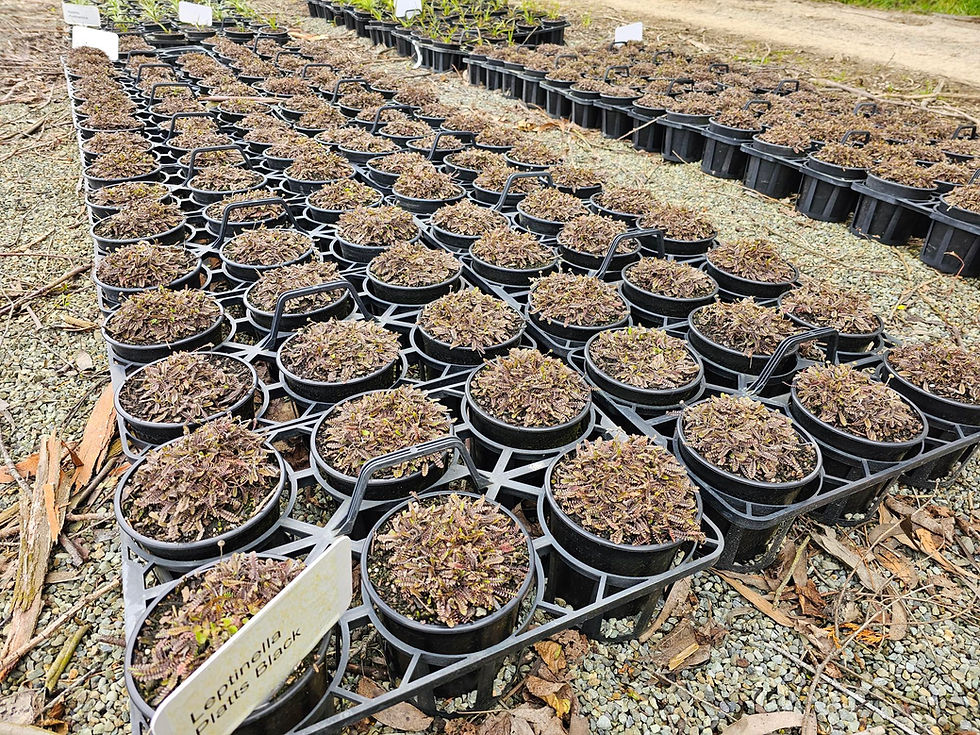
The near-black colour is a sun response. In full sun it holds charcoal, and in shade it fades back towards green and the plant stretches. Our own note is that it prefers full sun and will tolerate light shade, and light shade is the limit rather than a second option.
Soil matters for colour too. Rich, acidic and free-draining is what it asks for. Thin, lean ground will grow it, but you get a paler, sparser mat.
What does it cost to cover an area?
More than people budget for, and the arithmetic is short enough to do in your head.
Our price for 'Platt's Black' is $16.50 excluding GST for a 2.5L pot. For comparison, Southern Woods list theirs at $17.50 and The Plant Company at $13.95 for a 1.5 litre, both as at 9th September 2026.
Spacing for a solid cover sits at 200 to 300mm centres. Work it at 250mm and you need 16 plants per square metre. At 300mm centres it comes back to about 11.
So a strip 3m long and 600mm wide is 1.8 square metres, or 20 to 29 plants. Ten square metres of courtyard infill is 110 to 160 plants. That number decides most jobs. Leptinella goes into seams, panels and infill because covering a whole back lawn with it costs more than the lawn did.
Plant it wider than 300mm and it will still close, given a season or two of watering and weeding. You are trading money for time, and the weeds get the same time you do.
Where does Leptinella fall down?
In four places, and one of them is on a garden chemical company's website.
It arrives in lawns uninvited. Kiwicare publish a Leptinella identification and control page, listing it as a weed of damp lawns and recommending a selective broadleaf lawn herbicide. NZPCN records Leptinella squalida as a reported lawn weed in some urban areas. If a formal lawn butts up against your Leptinella panel, expect to be edging that join for the life of the garden.
It spreads by rhizome and does not stop at the plan. Surface runners move sideways through beds, under edging and into gravel. Easy to pull back, but it is an annual job rather than a one-off.
Weeds come up through it while it is establishing. A 50mm mat suppresses nothing in its first year. Every bare patch between plants is an open seedbed until the mat closes, and hand weeding is the only tool that does not also take the Leptinella.
Dry kills it faster than cold. Missouri rate 'Platt's Black' as intolerant of drought, and that matches what the wild plants tell us about where they choose to live.
What else does the same job?
If the site is too dry for Leptinella, the plant to look at is Acaena inermis 'Purpurea'. Purple-bronze mat, about 100mm tall by 600mm across, drought tolerant once established, and it dislikes compacted dry ground rather than dry ground as such.
The name is the useful bit. Inermis means unarmed, and this is the bidibid whose seed heads have no barbs on them. Socks and dog coats come through unharmed, which is not true of its relatives.
For a green mat on ground that stays damp, dioica is still the better answer than anything else we grow.
Common questions
Is Leptinella the same plant as Cotula?
Same plant, older name. Leptinella squalida was Cotula squalida and dioica was Cotula dioica, so old plant lists and older gardeners still use Cotula, and Missouri Botanical Garden's entry carries it as a synonym. Nothing has changed about the plant.
Am I definitely buying the species I asked for?
Not necessarily. NZPCN note that dioica is commonly available from retail and specialist native nurseries but usually incorrectly identified, and the genus is variable enough that this is an easy mistake to make rather than a dishonest one. If provenance matters for a job, ask the grower where their stock came from.
Can I mow it?
You can top it. In a large planting the spent flower stems can be taken off with a mower set high, and a trim back in early spring thickens the mat. Mowing it like turf, at turf height and turf frequency, is a different proposition and it will thin out.
Will it grow in shade?
Dioica copes with part shade better than the black one does. Leptinella squalida is recorded as tolerant of a wide range of soil, sun and shade conditions, but tolerating shade and colouring up in it are two different results. Full sun for 'Platt's Black' if the colour is the reason you are buying it.
How fast does it fill in?
Both are fast. 'Platt's Black' makes about 500mm of spread in two growing seasons in ground it likes. Plan on a season and a half from planting to a closed mat at 250mm centres, longer if it goes in late and dry.
When should I plant it?
Autumn is the pick, since the soil is still warm and the ground stays moist while the roots get going. Winter planting is fine too. A late spring planting is the one that needs a watering plan behind it, because a mat with roots less than a millimetre thick has nothing in reserve when the first hot week arrives.
Leptinella is a good plant put in the wrong place more often than most. Get the moisture right, keep the traffic light, and price the square metre before you draw the panel.


Comments